POS
Speed. Keyboard-first. Zero latency.
Cloud restaurant OS, built for India
Offline-first billing, a kitchen that never loses a ticket, and AI that's native to the product — not bolted onto a dashboard.
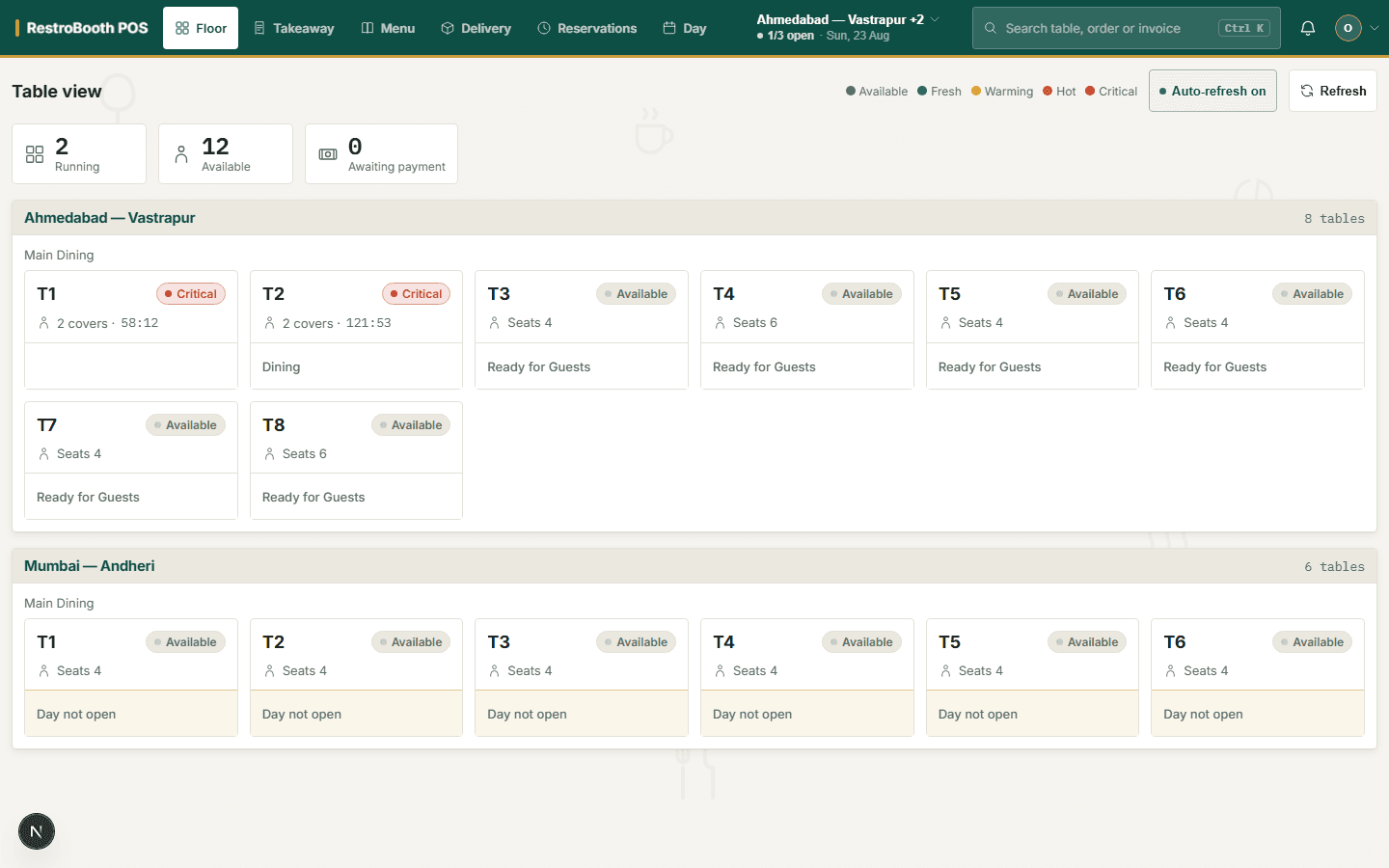
Table view — live
Where restaurant software actually fails
A bill that rounds wrong.
CGST and SGST are each worked out and rounded on their own — every paisa exact.
Every paisa is tracked exactly, never rounded early. CGST and SGST are each worked out and rounded separately — never one 5% tax cut in half.
A KOT that prints twice.
A KOT and a bill are never the same thing — separate numbers, separate history. A reprint is marked as a reprint — it never creates a second ticket.
A table stuck “occupied”.
The floor updates in real time, never a stuck label — merging, splitting, or moving a table shows the kitchen and the bill the exact same thing, instantly.
And then the WiFi drops at 8:40 on a Saturday.
Offline-first, not offline-tolerant
Zero duplicate bills. Zero lost items. Zero duplicate KOTs. This isn't a promise — it's what we test, every time.
One system, every surface
Speed. Keyboard-first. Zero latency.
Table state at a glance — merge, split, move.
Readable at 2 metres, ticket aging, one gesture: bump.
Take order at table, fire KOT, call for bill.
Browse, get guided, order, pay, feedback.
Menu, inventory, reports, AI insights, multi-outlet.
AI, native — not bolted on
AI reads the same order, menu, and review data every other screen does — it never touches your billing, and it never makes up a number it can't prove.
A taste concierge at the table — guides the order, doesn't just take it.
Reads real sales and margin data to say what to push, park, or cut.
A bad review doesn't sit in an inbox — it becomes a task with an owner.
Ask a question the way you'd ask a person — get a real number back, not a spreadsheet to dig through.
Every channel, one kitchen
An aggregator order lands in a staging inbox first. Accept it, and it becomes a normal order — same KOT, same KDS, same bill.
No second tablet for Swiggy, no separate app for Zomato — every order reaches the kitchen through the same pipe.
A rejected order never touches your orders at all — no ghost entries, nothing to void.
Aggregator payouts arrive as a CSV, matched line by line against your own settled bills.
Stock that keeps itself
Recipes tie every menu item to real ingredients — a sale deducts stock the moment it happens, whether it's cooked in-house or dispatched from a central kitchen.
Locked at the price paid when it sold — never re-priced later.
Every dish sold deducts its recipe automatically, at the price actually paid for those ingredients — not today's price, guessed backwards.
Move stock between two outlets under the same GST registration, and it's a plain delivery note. Cross into a different state's registration, and the system raises a real tax invoice — automatically, either way.
A line that's about to run dry is flagged while there's still time to reorder, not after a guest hears "we're out."
Built for the Indian F&B market
One login for every outlet and every brand in a shared kitchen — from day one, not bolted on later.
CGST and SGST are worked out separately and rounded correctly — on every invoice, at every outlet.
Zomato and Swiggy orders land on the same kitchen screen as a walk-in table — no second screen to watch.
Pay at the table or at the counter — the invoice number never changes because of how it was paid.
Loyalty that doesn't leak
A loyalty balance belongs to one brand — never pooled across your whole chain, never visible to someone else's manager.
1 point per ₹100 spent · 1 point = ₹1 · never below zero.
A guest earns points at any outlet of yours — but never spends them against a different brand, even one sharing the same kitchen.
The balance itself is the limit. A cashier can redeem points a guest has — never invent points that were never earned.
Every earn, redeem, and reversal is a permanent record. Nothing is edited after the fact — only new entries are added.
Tally-ready export
Two exports: a day-summary covering your full history, or per-bill invoices for the last 13 months. Settled bills only — money that actually moved.
One row per GSTIN, per business day. Covers all time — it reads a rollup, not a raw table.
One row per invoice, real amounts. Only the last 13 months — real invoice data, not a projection.
Older than 13 months? It tells you plainly — never a partial answer.
Proof of craft
of every money, tax, and KOT rule is tested automatically, every single time.
rounding errors. Every paisa is calculated exactly and checked on our servers, not your device.
ways we've tried to break into another restaurant's data — and failed, every time.
duplicate bills or lost items — even when the WiFi drops mid-service.